
After moving from Manchester to a semi-rural village in Cheshire this summer, I decided to try to get involved in the local community. I joined a few groups on Facebook and noticed that the village prides itself on fostering a creative community. Sadly, what I found felt closer to the embodiment of what happens when culture dies and crafts thrive.
There were craft fairs, wellness retreats, local workshops, handmade products and an arts centre forever showcasing the works of various artists. On the surface, it should have felt charming. This is the kind of place where you can still buy eggs from the side of the road, where community noticeboards ought to feel more human than algorithmic, where creativity should still have soil under its fingernails. Instead, I kept seeing small businesses using ChatGPT to design flyers for their events, services and products. Even meditation retreats were being advertised in banal high-gloss typography with imagery that set my teeth on edge.
The irony was almost too much. A village championing creativity while quietly outsourcing its visual language to AI felt less like progress and more like cultural self-lobotomy with Canva-friendly borders. So, naturally, I decided to be a contrarian.
When Creativity Becomes a Template
I made the point that the overreliance on AI in a place that claims to value creativity makes the village appear as though it has no soul. I was expecting a little backlash; that comes with saying anything mildly rousing in a public forum. What I wasn’t expecting was for people to use ChatGPT to generate their counterpoints, which they then “humorously” provided, as though delegating their defence of AI to AI was some kind of knockout blow rather than an accidental performance-art piece about the death of critical thinking.
Do these people know that AI is a machine of hyper-validation? More importantly, do they know that what little critical thinking power they had is being erased by their overreliance on ChatGPT? Or maybe I am being too generous. Maybe some people never had the power of critical thinking in the first place. Maybe they only knew how to tribalistically follow the script belonging to their ideology.
One person responded with the kind of motto-thinking that has infected every corner of public life: “out with the old, in with the new”, “keep up, or you’ll be left behind.” It proved my point more strongly than anything I could have written myself. Suddenly, all those home décor products with “Live, Laugh, Love” and “Keep Calm and Carry On” plastered across them started to make a lot more sense. They are hardly the proverbs of Confucius, but they still give people codes to live by. They offer pre-packaged thought for people who want the emotional comfort of having a worldview without the inconvenience of building one.
If this sounds harsh, it is because there is something spiritually depressing about watching a supposedly creative community confuse novelty with imagination. AI can generate a flyer. It can generate an argument. It can generate the illusion of competence. What it cannot generate is taste, context and soul.
The Village, The Pint Mug and The Blinkers
In this Reform-voting town, where you can buy mugs with Nigel Farage smugly brandishing a pint in his working-man cosplay outfit at a stall on market day, I immediately got the sense that my relatively liberal and progressive morals were not going to be a natural fit. The politics of the place seemed written into the objects, the jokes, the suspicion of anything that sounded too “woke”, too urban, too soft, too bothered.
But what unsettled me more than the politics was the blinkeredness. People did not seem to see the harm in AI replacing graphic designers. They did not seem to connect the casual normalisation of automation with the obliteration of futures belonging to the children and grandchildren they happily display in their profile pictures. They see record numbers of people out of work, yet refuse to believe that people might truly be running out of employment options in an era when jobs are being wiped out by AI automation, collapsing high streets and an economy that has made human labour feel increasingly disposable.
The same people who romanticise community seem perfectly willing to erode the economic foundations that allow creative communities to exist. They want the market stall, the local artist, the independent shop, the handmade product and the village fair, but they also want free design, instant copy, automated admin and frictionless convenience. They want the aesthetics of humanity without the cost of sustaining human beings.
This is not simply about a bad poster for a meditation retreat. It is about the ease with which people will celebrate “creativity” while hollowing out the labour behind it. It is about the smug belief that being able to prompt a machine makes you adaptable, when it might just make you complicit in stripping value from the work of people who spent years learning how to think visually, write clearly, compose, edit, design, draw, sing, photograph, code or make.
Identity-Based Thinking Is Not Thinking
The bleakest part is that I cannot simply place myself on the other side of the argument and feel smugly at home there either. I am also ostracised by the radical nature of the left, where questioning the party line can make you sound, in the eyes of the most online moral enforcers, indistinguishable from the people they have already decided are beyond saving.
I found myself agreeing with Aperture in his recent video about society being stuck on the lowest level of thinking, locked into identity-based thinking, which is not really thinking at all. It is a tribal act. There is no need to think because truth has become less important than identity. It does not matter how intelligent people are if emotion is always placed above logic, if disagreement is treated as contamination, if curiosity is mistaken for betrayal.
That is why social media rhetoric has become so savage. Pile-ons grow more extreme because they are not really conversations; they are public rituals of belonging. People prove their moral identity by attacking the person who said the wrong thing, asked the wrong question or failed to repeat the correct slogan with sufficient speed. People who question anything are treated with the same venom as people who actively support horrors. Nuance has been murdered in broad daylight, and everyone keeps filming the body.
There is a sickness in society, and our overreliance on AI, our willingness to delegate critical thinking, is only going to make it worse. If people already think in mottos, what happens when they use AI to polish those mottos into something that sounds intelligent? If they already confuse emotional certainty with truth, what happens when a machine reflects their assumptions back at them in grammatically fluent paragraphs?
AI doesn’t challenge most people who spill their secrets, spites and woes into it. It flatters them. It organises their existing instincts into plausible form. It gives the illusion of depth to people who have not actually gone deeper. That is why it is dangerous in a culture already starving for critical thought.
The News Cycle as Sleeper-Agent Activation
Unless we remove our identities from our ideas, become less afraid to think beyond party lines, and grow more receptive to views that do not mimic our own, the tribalistic, divisive nature of society will only become more extreme. There seems to be a new issue to divide us every day to add to the existing body of divisive topics, Brexit, abortion, religion, LGBT rights, politics, AI, vaccines: society is fragmenting, and our window of tolerance for other people is getting smaller and smaller.
When something surfaces as a new cultural talking point, we jump on it with our partisan knives fully sharpened. We rarely stop to wonder why it has been blown up to such a degree. Tiny events choke news feeds. Thousands of YouTubers make video essays. Just as many journalists chime in to add pomp to a conversation upheld by the vomited opinions of people who mostly want to affirm their stance on an issue.
Yet, when you ask people to think about why they are waking up to cultural talking points like sleeper agents whenever something surfaces, you instantly become the enemy. Are our identities really so fragile? Is it so unbearable to not know something? To be publicly silent on an issue you’re not completely competent in speaking on? It is okay to be curious. It is okay to pause before attaching your soul to a take. It is okay to admit that you do not know enough yet. Because even the people who think they know don’t know anything beyond a headline, a depressing image; they think they can get all the context, that they don’t need to dig deeper to find the nuance, which, sadly and inconveniently for some, exists EVERYWHERE.
That brings us back to the Dunning-Kruger effect, where the stupid are full of confidence and the intelligent are full of doubt. In a world where there are three sides to the story- yours, mine and the truth- doubt should not be treated like weakness. It might be the last sign that a person is still thinking.
Conclusion: What Happens to Art When Nobody Can Think?
You frequently see people declaring, “if you think X, delete me”, as though witnessing an opposing view is somehow too painful to survive. We need to get comfortable with the idea of autonomy again. We need to remember that disagreement is not violence, curiosity is not betrayal, and thinking is not the same as selecting whichever opinion best matches the identity we have chosen for public display.
Because if we lose the ability to think critically, what happens to art?
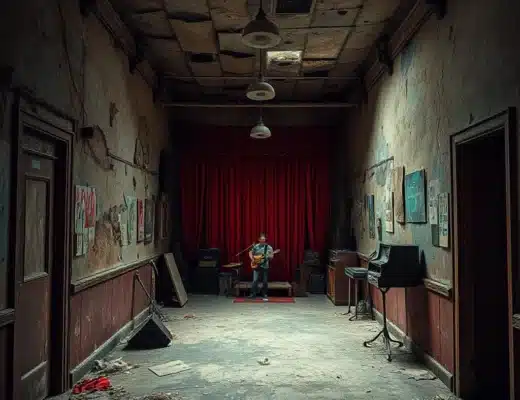
Will there be anything left to express through music, or will we be left with carbon-copy love songs, algorithmic dance anthems, AI-designed posters and artists too afraid to step outside whichever ideological lane keeps them safe? Art cannot survive if every idea must first pass through a tribal compliance check. It cannot survive if people outsource their thinking to machines and their morality to slogans. It cannot survive in a culture where “creativity” is celebrated only as an aesthetic, while the difficult, dangerous act of thinking for yourself is treated as antisocial.
The village taught me something I did not expect to learn from Facebook groups and ugly AI flyers. It taught me signs of the death of critical thinking are cheerful templates, recycled mottos, generated rebuttals, political merchandise, social-media pile-ons and the slow shrinking of our tolerance for complexity.
When it is finally in the ground, people will probably ask ChatGPT to make a poster for the funeral.
Article by Amelia Vandergast
Art by Maria Tokar


No Comments